From Idea to Launch: How Software Actually Gets Built
Understanding the journey from business idea to production release through prototypes, sprints, and continuous iteration.

Sandeep Varma

A practical walkthrough of the Software Development Lifecycle for non engineers and cross functional teams
In this post, we are going to walk through the journey of how software moves from a simple idea to something that real users can access and use. If you work with engineering teams, are transitioning into technology, or simply want to better understand how software is built, this guide will give you a clear and structured overview.
To make this practical, we will use a relatable example. Imagine your company currently uses an external messaging platform like Slack or Microsoft Teams. Over time, leadership decides that licensing costs are too high and that building an internal messaging tool could make financial sense. There are many strategic factors behind a buy versus build decision, and that is a deeper topic for another post. For now, let us assume the decision has been made to build.
Let us walk through what happens next.
The Idea and Business Evaluation
Every software journey starts with an idea. That idea can come from a CEO, a product manager, a business development team, or even an engineer. In modern organizations, strong ideas can originate from anywhere. What matters is that the idea is evaluated seriously.
Before engineers write a single line of code, the business typically evaluates whether building the solution makes sense. Does it justify the cost? Do we have the right talent? What are the risks? What are the expected benefits? Once leadership decides to move forward, the initiative transitions into structured product planning.
Product Defines the Vision
After approval, the product team translates the idea into something more concrete. In our example, the goal is to build an internal messaging tool. Product begins defining what that tool should do. Should users be able to send direct messages? Should there be group channels? Should there be file sharing? Should there be notifications?
These ideas are written formally as user stories or feature definitions inside tools such as Jira or other tracking systems. A user story simply describes how the system should behave from the user’s perspective. At this stage, the list of features begins to grow into what is often called a backlog.
The product team is focused on defining value. They care about what the system should accomplish, not yet how it will be implemented.
Technology Validates the Idea Through Prototyping
Once there is enough clarity around the vision, technology engagement begins. Engineers and architects evaluate feasibility. Before building a full product, they often create a prototype.
A prototype is not the final product and it is not even the first customer ready version. It is a technical experiment. It answers a simple but critical question: can this work?
In our messaging example, engineers might build a minimal proof of concept that allows two users to send messages in real time. There may be no polished interface, no advanced authentication flow, and no scalability built in. The goal is purely validation.
This step is extremely important. Many teams fail because they assume something will work without validating constraints such as security controls, infrastructure limitations, or integration requirements. A feasibility prototype allows teams to fail fast and adjust direction early before investing significant time and money.
Once the prototype demonstrates that the concept is technically viable, the team moves into structured development.
Defining the Minimum Viable Product
While prototyping validates feasibility, product continues refining the feature set. Instead of building every possible feature immediately, teams define an MVP, or Minimum Viable Product.
The MVP represents the smallest set of features that deliver meaningful value. In our messaging tool example, that might include user authentication, direct messaging, basic channels, and message history. Advanced features such as reactions, analytics, or mobile optimization may come later.
At this stage, the engineering team begins deeper collaboration with product.
Refinement and Estimation
Engineering teams typically hold regular refinement sessions. During these sessions, product presents user stories and engineers ask clarifying questions. Are there edge cases? Are there design dependencies? Are there performance considerations?
This is where implementation thinking begins. Engineers discuss high level technical approaches and identify risks. At the end of refinement, the team estimates the effort required for each story.
Estimation is usually done in story points, which represent relative complexity. Teams often use a Fibonacci style sequence such as one, two, three, five, or eight. The higher the number, the greater the complexity or uncertainty.
The purpose of estimation is not to predict exact hours. It is to help the team understand how much work can realistically be completed within a given time period.
Sprint Planning and Capacity
Most modern teams work in sprints, which are fixed time periods commonly lasting two weeks. During sprint planning, the team looks at their total capacity and selects stories from the backlog that fit within that capacity.
Each engineer has a general sense of how many story points they can handle in a sprint. Junior engineers may take on fewer points, while senior engineers may take on more complex work. The total sprint commitment reflects what the team believes can be completed within those two weeks.
Once the sprint begins, engineers start building.
Development, Testing, and Release
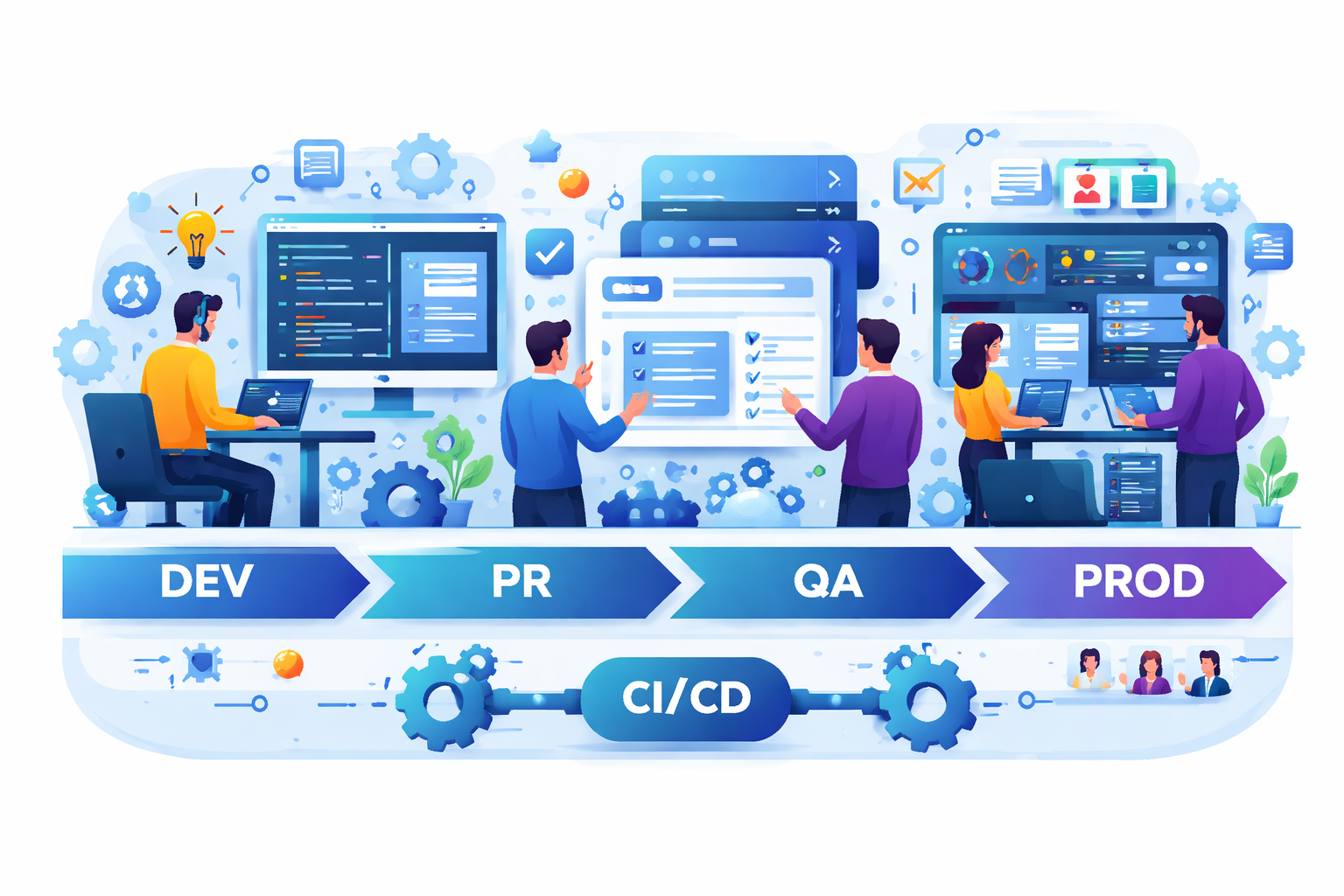
After engineers pick up their assigned stories, they move into the detailed implementation phase. This includes writing code, performing testing, reviewing changes with peers, and validating that the feature behaves as expected.
There is a deeper technical process that happens within each story, and we will explore that in a follow up post. For now, it is enough to understand that each completed story moves the product closer to the MVP. If you want to understand that inner journey in detail, From Requirement to Release: What Really Happens Inside Engineering walks through exactly what happens after a story is assigned to an engineer.
When all committed stories are completed and validated, the MVP can be released to users.
Iteration and Continuous Improvement
Releasing the MVP is not the end of the journey. It is the beginning of learning.
Once real users interact with the messaging tool, feedback starts flowing in. Some features will need improvement. New needs will emerge. Priorities may shift. Product updates the backlog with new stories, and the cycle begins again.
Refinement sessions continue. Sprint planning continues. Engineers deliver incremental improvements sprint after sprint.
A healthy backlog usually contains enough well defined work for the next two or three sprints. This ensures that if engineers complete work earlier than expected, there is always meaningful work ready to be pulled into the current sprint.
This iterative cycle is how modern software is built. It evolves step by step, guided by feedback, shaped by constraints, and delivered in increments.
Closing Thoughts
Understanding the Software Development Lifecycle helps non engineers collaborate more effectively with technology teams. It clarifies why feasibility matters, why estimation exists, why sprints are structured the way they are, and why products are released in increments instead of all at once.
In the next post, we will zoom into what happens when an engineer picks up a single story and walk through the detailed journey from code to production.
If you work closely with engineering teams, what part of this lifecycle has been the most confusing or surprising to you? Reflect on where collaboration feels smooth and where friction tends to appear. That awareness alone can dramatically improve how teams work together.
Did you find this useful?
Comments
Loading comments...
Please log in to post a comment.
About the author

I write about leadership and software engineering through the lens of someone who’s worked as a software engineer, product owner, and engineering manager. With a Bachelor’s in Computer Science Engineering and an MBA in IT Strategy, I bring together deep technical foundations and strategic thinking. My work is for engineers and digital tech professionals who want to better understand how software systems work, how teams scale, and how to grow into thoughtful, effective leaders.
Continue reading
How Software Systems Scale: From One Machine to Many
From a single server to intelligent auto scaling, a practical mental model for how modern software systems grow with demand.
Virtualization: The Technology That Quietly Powers the Cloud
How one physical machine can become many computers and why this idea made modern cloud computing possible