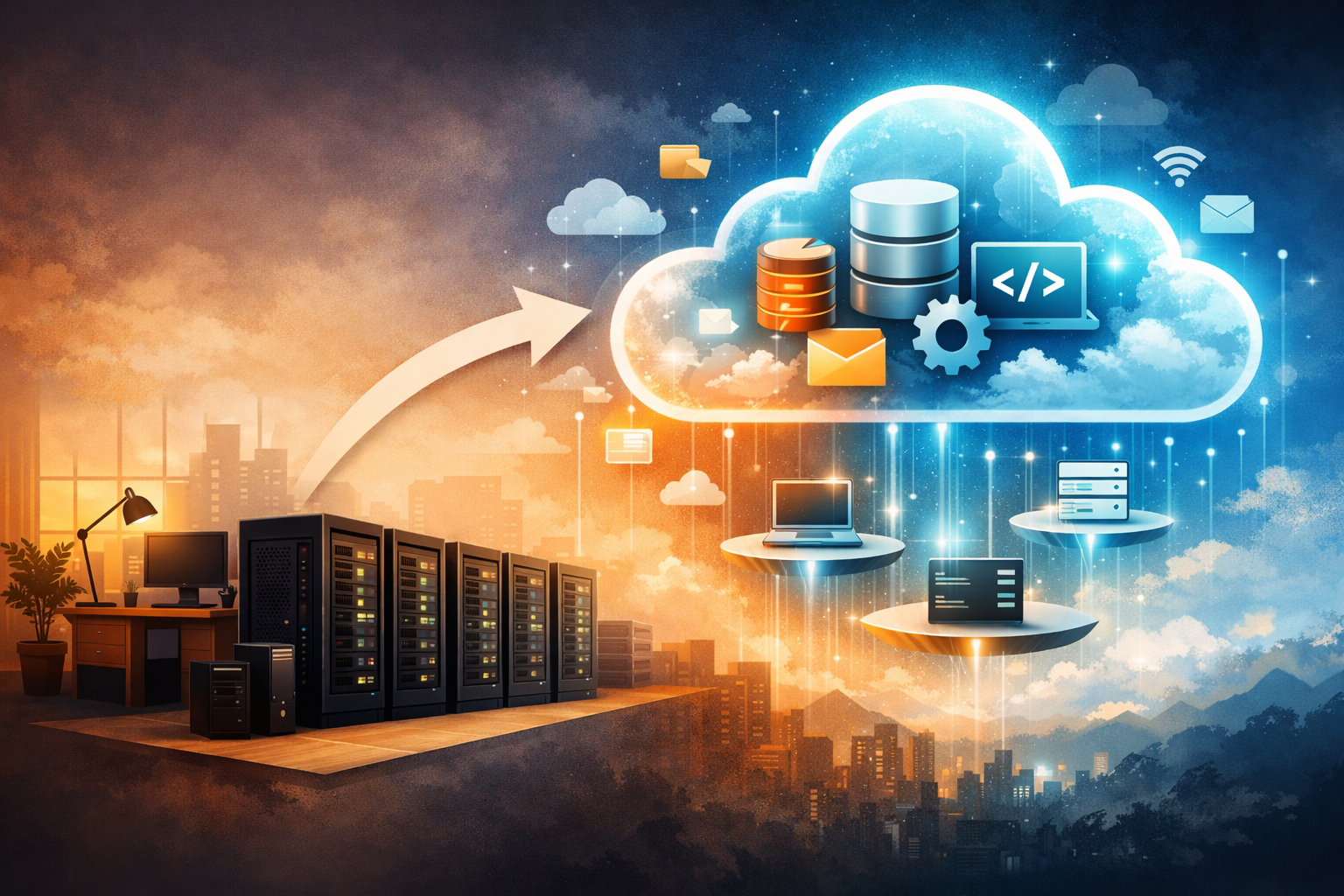
Virtualization: The Technology That Quietly Powers the Cloud
How one physical machine can become many computers and why this idea made modern cloud computing possible

Sandeep Varma

Why Companies Needed Virtualization
In the early days of modern software systems, running applications meant running them directly on physical machines. Companies would purchase servers, install operating systems on them, and then deploy applications on top of those machines.
At first glance, this seems straightforward. But this approach created a surprisingly inefficient problem.
When companies purchased a server, they usually bought a large and powerful machine. The reason was simple: they expected their applications and user base to grow over time. If they bought a small server and demand increased later, upgrading would be painful.
Upgrading meant buying a larger machine, physically installing it, migrating data, reinstalling software, and moving traffic from the old machine to the new one. That process was expensive, risky, and time-consuming.
To avoid this headache, companies often purchased bigger servers than they actually needed.
The result was predictable: a server might only use 10–20% of its capacity, leaving the rest of the machine idle for months or even years while companies waited for growth that might never come.
This was a massive waste of resources.
The industry needed a better solution.
The Core Idea Behind Virtualization
Virtualization introduced a simple but powerful concept: instead of running just one operating system on a physical machine, you could run multiple virtual machines on the same hardware.
A piece of software called a hypervisor sits on top of the physical hardware and allows the machine to be divided into multiple isolated environments. Each environment behaves like its own independent computer.
These virtual machines can each run their own operating system and applications, even though they all share the same underlying hardware.
From the perspective of the user, each virtual machine looks and behaves exactly like a real computer.
In reality, however, all of them are sharing the same physical server.
This meant that instead of dedicating an entire server to a single application, companies could run multiple applications on the same machine. Suddenly, the unused capacity of large servers could be utilized much more efficiently.
Instead of wasting 80% of a server’s power, organizations could fill that machine with multiple workloads.
The impact of this shift was enormous.
Why Virtualization Was Such a Big Deal
Virtualization fundamentally changed how companies thought about infrastructure.
Instead of managing physical machines directly, they could now create, destroy, and manage virtual machines using software.
This provided several major advantages:
- Better hardware utilization
- Lower infrastructure costs
- Faster provisioning of new machines
- Greater flexibility in deploying applications
Most importantly, it made it possible to treat computing resources much more dynamically.
Instead of buying hardware for every new application, companies could create virtual machines on existing servers.
This concept laid the foundation for something much bigger.
Virtualization and the Rise of Cloud Computing
If you have used a cloud provider like AWS, Google Cloud, or Azure, you have already benefited from virtualization even if you never thought about it. If the concept of cloud computing is still new to you, What Does the Cloud Actually Mean? provides the mental model for why companies moved to renting infrastructure in the first place.
When you request a machine in the cloud, you might ask for something like:
- 4 CPUs
- 16 GB of memory
- 100 GB of storage
From your perspective, it feels like you are renting a complete computer.
In reality, what you are receiving is a virtual machine carved out of a much larger physical server inside a data center.
Cloud providers run extremely large machines and divide them into many smaller virtual machines using virtualization technology.
Each customer receives what appears to be their own machine, but underneath the hood, many customers may be sharing the same physical hardware.
This model is what makes cloud computing economically viable.
Without virtualization, cloud infrastructure as we know it today would not exist.
Multi-Tenancy: Sharing Machines Safely
When multiple customers share the same physical machine, an important concept comes into play: multi-tenancy.
The word "tenant" here is similar to a tenant in an apartment building.
Multiple tenants live in the same building, but each has their own apartment. They do not have access to each other’s living spaces.
Similarly, in a cloud environment, multiple customers may share the same physical server, but each one operates inside an isolated virtual machine.
Cloud providers invest heavily in ensuring that one customer cannot access another customer's data or processes.
Isolation between virtual machines is critical. Without it, industries like healthcare, finance, and government would never trust cloud infrastructure.
There are also scenarios where companies require even stronger guarantees. In those cases, cloud providers offer dedicated machines, where an entire physical server is reserved for a single customer.
However, for most applications, the standard virtualization isolation provided by cloud providers is more than sufficient.
Why Most Developers Don’t Think About Virtualization Anymore
Today, virtualization is still one of the most important technologies in modern infrastructure.
But most software developers rarely interact with it directly.
Cloud platforms have abstracted away almost all of the complexity. Developers simply request the resources they need, and the cloud provider handles the rest.
Because of this abstraction, virtualization often fades into the background of modern software development.
But the ideas behind virtualization did not stop evolving.
In fact, they led to a new technology that has had an even bigger impact on how modern applications are built and deployed.
That technology is containerization.
In the next post, Containerization: How Modern Applications Run the Same Everywhere, we explore how containers take the ideas behind virtualization even further and why technologies like Docker have become essential tools for modern software engineers.
Did you find this useful?
Comments
Loading comments...
Please log in to post a comment.
About the author

I write about leadership and software engineering through the lens of someone who’s worked as a software engineer, product owner, and engineering manager. With a Bachelor’s in Computer Science Engineering and an MBA in IT Strategy, I bring together deep technical foundations and strategic thinking. My work is for engineers and digital tech professionals who want to better understand how software systems work, how teams scale, and how to grow into thoughtful, effective leaders.
Continue reading
From Idea to Launch: How Software Actually Gets Built
Understanding the journey from business idea to production release through prototypes, sprints, and continuous iteration.
Containerization: How Modern Applications Run the Same Everywhere
Why packaging software with its environment solved the famous “works on my machine” problem