What Does ‘The Cloud’ Actually Mean? A Simple Mental Model
A buzzword free explanation of cloud computing for people who work with software but do not build it.

Sandeep Varma

Cloud computing is everywhere today.
Almost every application we use, whether we are shopping online, watching videos, collaborating at work, or scrolling through our phones, relies on cloud technologies in some way. At this point, very little modern software is built entirely without it. And yet, the word cloud often feels vague, overloaded, or hand-wavy, especially if you are not writing code yourself.
This post is my attempt to demystify what cloud computing actually means for a non-technical audience. If you work as a project manager, product manager, program manager, or in any role that collaborates closely with engineers, this is meant to give you a solid mental model you can rely on, without drowning you in jargon.
Every Software System Needs a Computer Somewhere
Let’s start with the most basic idea.
Any software application you interact with needs computing power to function. Sometimes all of that computing happens on the device you are holding. Other times, it does not.
If you install a simple game on your phone and it works entirely offline, that means everything the game needs lives on your device. The logic, the data, the visuals, all of it runs locally. No internet connection is required because no other computer is involved.
But most applications do not work like that.
If you are shopping online, watching a movie on a streaming service, running a search, or pulling up work data, your device is only part of the story. Your phone or laptop sends a request over the internet, and some other computer somewhere responds with data. That computer might retrieve information, process it, and send the result back to you.
Once you understand this, one thing becomes very clear. For any system that needs data from outside your device, a computer somewhere else must be doing work on your behalf.
That is where computing comes into the picture.
Storage Is Just a Computer Holding Data
Before we talk about the cloud, it helps to understand storage.
When you watch a movie on a streaming service, that movie is not magically floating in the air. It is stored on a computer somewhere. That computer might hold thousands or millions of files, but at the end of the day, it is still a machine storing data and sending it to you when you ask for it.
This applies to photos, documents, videos, backups, and logs. Storage always lives on a computer. The only question is whose computer it is.
Cloud providers offer storage as a service. You rent space on their computers instead of owning your own. From your perspective, you upload data and retrieve it when needed. The underlying machines, disks, and infrastructure are hidden from you.
There is a small amount of computing involved in storage, since data must be retrieved and sent back to you, but that processing is minimal. It is so small and standardized that cloud providers simply absorb it into the service and pricing.
You never have to think about it.
Databases Add More Computing on Top of Storage
Databases build on top of storage.
A database does not just store data. It organizes it, indexes it, searches it, filters it, and updates it. When you ask a database a question, it has to do real work to answer that question efficiently.
That means databases have more computing power associated with them than simple storage. They still run on computers, but those computers are optimized for searching and processing data rather than just holding files.
Cloud providers let you rent databases the same way they let you rent storage. You do not buy the machines. You do not manage the disks. You simply use the database and pay for it based on usage.
From your point of view, you get data in and out. From the provider’s point of view, they are running and maintaining large fleets of computers to make that possible.
Computing Is Where the Cloud Becomes Most Visible
Now we get to computing in the more traditional sense.
Computing is where application logic runs. This is where code executes, decisions are made, and responses are generated. And this is where cloud computing offers the widest range of options.
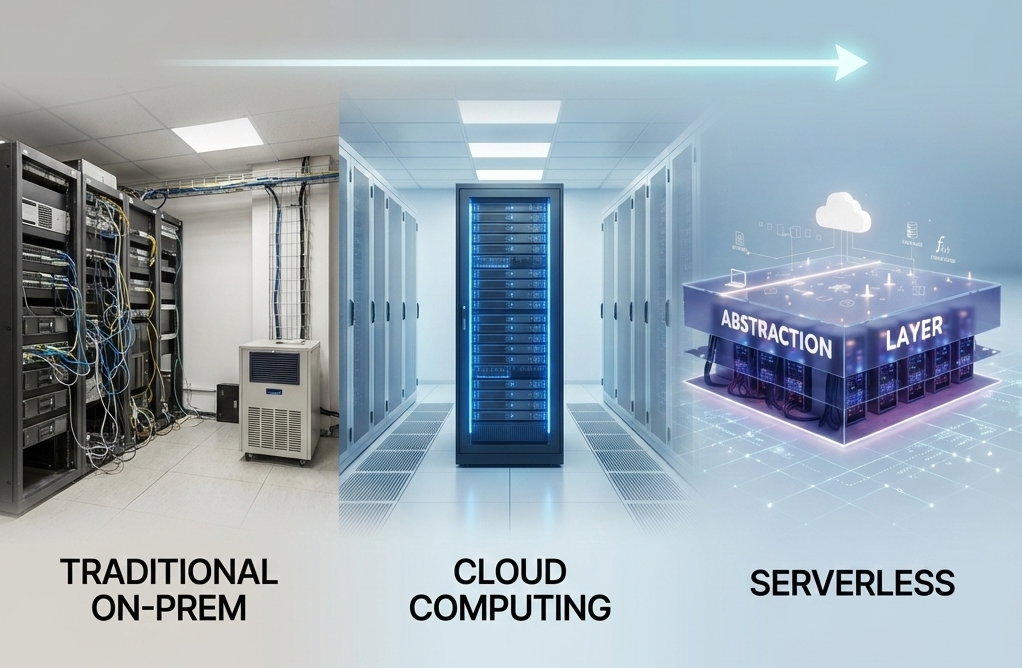
At the most hands-on level, cloud providers let you rent an actual computer. You may have heard terms like virtual machines or services such as EC2 on Amazon. In this model, you get a machine in the cloud and you are responsible for almost everything. You install software, configure it, run your application, update it, and keep it healthy.
This model is very close to owning your own servers, except the hardware lives in someone else’s data center.
At the other end of the spectrum, cloud providers offer computing models where you do not manage servers at all. You simply ship your application code, and the cloud provider takes care of running it, scaling it, and keeping it available. This is often referred to as serverless computing.
If you want to go deeper into that model, I have a separate post that explains serverless in detail without assuming an engineering background: Serverless Explained: From Servers to Abstractions.
Some platforms take this even further by breaking computing into very small units called serverless functions, sometimes referred to as lambdas in AWS. Each function performs a small task, runs only when needed, and then stops. You never see a server. You never manage one. You just write the logic. I have another post that dives specifically into this model - Serverless Functions: When Writing Just Code Is Enough.
The important thing to understand here is not the terminology. It is the idea that cloud computing offers multiple levels of abstraction, from managing everything yourself to managing almost nothing at all.
Why Companies Chose the Cloud in the First Place
Now that we understand storage, databases, and computing, the question becomes why companies moved to the cloud at all.
To answer that, it helps to think about a familiar analogy.
Imagine you want to run a business and you need an office space. You have two options. You can buy land, design a building, construct it, maintain it, secure it, and upgrade it over time. Or you can rent office space from someone whose entire business is building and maintaining offices.
If your expertise is selling products or services, does it really make sense to become an expert in real estate, construction, and facilities management as well?
Historically, companies did exactly that with software. They built data centers, bought servers, maintained them, cooled them, powered them, secured them, and replaced them when they failed. This was called running on premises, or on prem.
It worked, but it forced software companies to spend enormous time and money on things that were not their core business.
Cloud computing changed that model. Instead of owning everything, companies rent computing resources from providers whose sole job is to run data centers efficiently at massive scale. Those providers can do it cheaper, better, and more reliably than most individual companies ever could.
From a business perspective, the cloud is outsourcing infrastructure the same way renting office space outsources building maintenance.
Why It Is Called the Cloud at All
The term cloud itself is not particularly important.
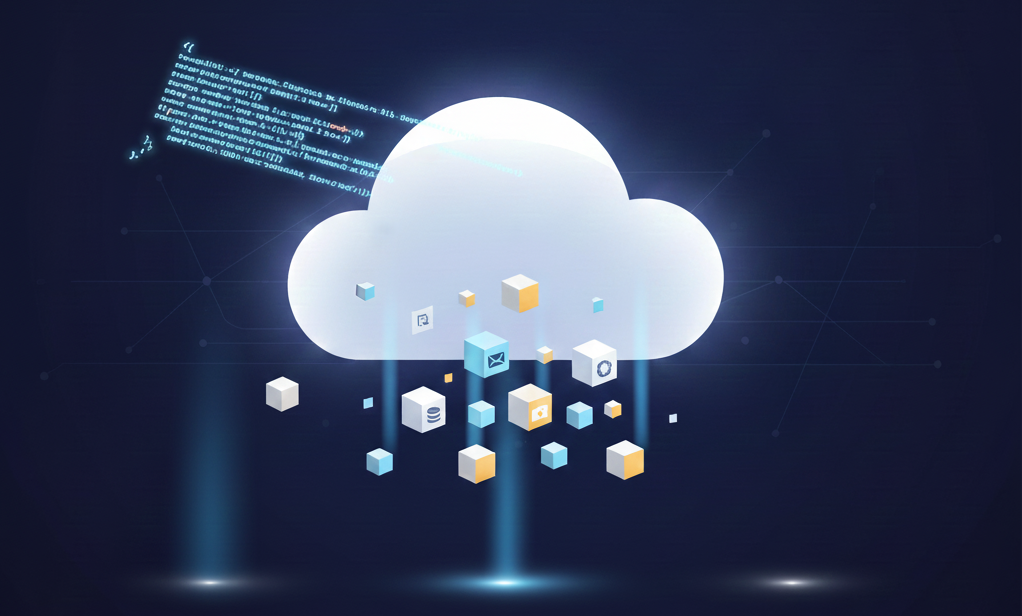
Historically, diagrams used a cloud shape to represent the internet or external systems that were not fully specified. Over time, the name stuck. Today, cloud simply means that you can access computing resources over the internet without owning or managing the underlying hardware yourself.
You do not see the machines. You do not know where they are. And you usually do not need to care.
What matters is that computing power, storage, and data are available on demand, when you need them, without upfront investment in physical infrastructure.
Wrapping Up the Mental Model
At a very basic level, cloud computing is not mysterious.
Software needs computers to run. Those computers can belong to you, or they can belong to someone else. The cloud is what we call the model where someone else owns and operates the computers, and you rent what you need over the internet.
Once you understand that foundation, many conversations about software architecture, scalability, cost, and reliability start to make a lot more sense.
In future posts, we can build on this grounding and explore ideas like serverless computing, scalability, and why modern systems are designed the way they are. But this mental model is the one I always come back to.
And it is usually enough.
What Do You Think?
If you work closely with engineers, did this explanation match how you think about the cloud today?
Was there a moment when this clicked for you, or a question you still find confusing?
I would love to hear what parts resonated and what you would like to explore next.
Did you find this useful?
Comments
Loading comments...
Please log in to post a comment.
About the author

I write about leadership and software engineering through the lens of someone who’s worked as a software engineer, product owner, and engineering manager. With a Bachelor’s in Computer Science Engineering and an MBA in IT Strategy, I bring together deep technical foundations and strategic thinking. My work is for engineers and digital tech professionals who want to better understand how software systems work, how teams scale, and how to grow into thoughtful, effective leaders.
Continue reading
Should EMs Code? A Balanced Perspective
An experience-driven argument for why writing production code often feels right in the short term, but quietly undermines the real responsibilities and long-term impact of engineering management.
Partnering on Engineering with Product and Design
A practical look at how engineering managers align product goals, technical feasibility, and design decisions to deliver meaningful software.