Understanding APIs: Where Business Logic and System Control Live
Understanding how APIs coordinate frontend requests, enforce business logic, and safely interact with your database

Sandeep Varma

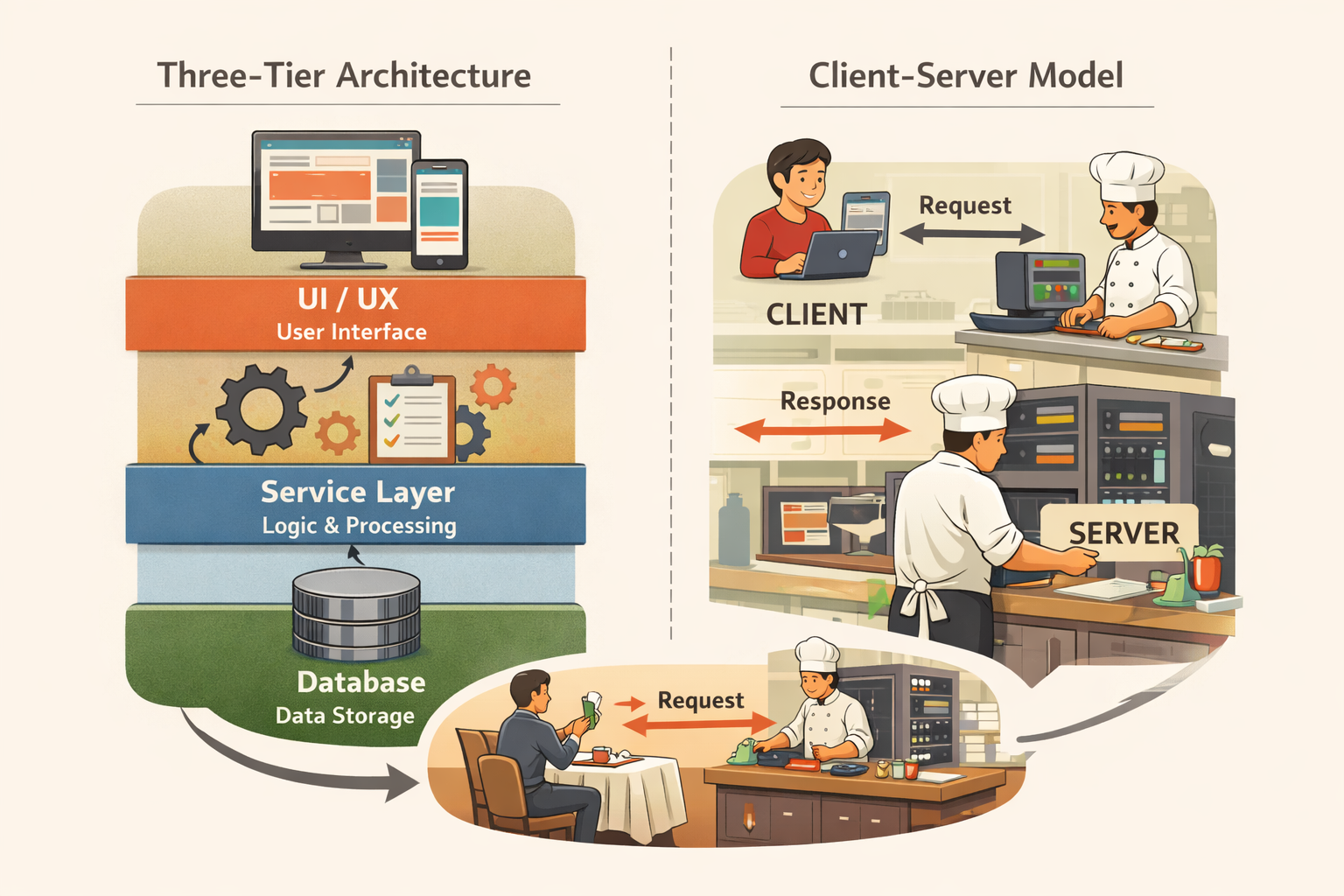
Before we go deeper into APIs, it is important to understand that this post builds directly on the mental model introduced in my earlier article on three tier architecture. In that post, I explained how modern software systems are typically divided into three layers: the frontend, the API layer, and the database. That foundational model helps simplify how we reason about responsibility, scale, and system boundaries.
If you are new to that concept, I recommend starting there to understand the broader architectural structure (Three-Tier Architecture). If you are already familiar with the three tier model, you can continue reading as we focus specifically on the API layer and its role within that structure.
In the previous article on the frontend layer, Beyond the UI: A Deeper Dive into How Frontend Systems Really Work, we examined what happens inside the browser. Files are delivered, HTML, CSS, and JavaScript are interpreted, and computation happens on the user’s device. The frontend shapes experience and interaction.
But the frontend alone cannot store data, enforce rules, or guarantee system integrity.
When the frontend needs information or wants to change something in the system, it must communicate with another layer.
That layer is the API.
What an API Really Is
API stands for Application Programming Interface. The name may sound abstract, but the idea is straightforward. An API is a controlled entry point into your system. It acts as the intermediary between the user interface and the underlying data.
The frontend cannot directly access the database. It cannot freely read or write data. Instead, it must send a request to the API. The API receives that request, evaluates it, applies business rules, and determines what should happen next.
This separation is intentional. Unlike frontend code, which runs on the user’s device, the API executes on servers that you control. That difference is critical for security, consistency, and reliability. The API layer represents a trusted environment where system level decisions are enforced.
What Happens When the Frontend Needs Data
Consider a simple example. A user clicks a button labeled “View Orders.” From the user’s perspective, the page updates and order information appears. From an architectural perspective, several steps happen behind the scenes.
First, the frontend sends a request to the API asking for order data. That request travels over the network to a server. The API receives the request and checks whether the user is authenticated. If the user is not logged in, the request may be rejected immediately.
If authentication succeeds, the API applies business logic. It determines which orders the user is allowed to see. It may filter results based on permissions, account ownership, or account status. Only after these rules are evaluated does the API query the database for the appropriate records.
Finally, the API returns structured data back to the frontend, and the frontend renders it for the user.
The API acts as both gatekeeper and coordinator. It does not focus on presentation. It focuses on correctness and enforcement.
What an API Response Looks Like
Unlike the frontend, which deals with layout and visual presentation, APIs deal with structured data. A simple request might look like:
GET /api/orders
The response might look like this:
{
  "orders": [
    {
      "id": 1023,
      "total": 49.99,
      "status": "Shipped"
    },
    {
      "id": 1024,
      "total": 19.99,
      "status": "Processing"
    }
  ]
}
This is not a webpage. There are no fonts, no colors, and no buttons. It is simply structured information, typically formatted as JSON.
The frontend receives this data and decides how to display it. The API does not care about layout or styling. It cares about returning accurate and permitted information.
How the Frontend Uses API Data
One helpful way to think about the frontend is that it often contains placeholders waiting to be filled.
For example, a user profile page might define space for a username, an email address, a profile picture, and recent activity. The layout and structure are already in place when the page loads. However, the actual data does not live inside those frontend files.
Instead, the frontend sends a request to the API asking for the relevant information. The API responds with structured data, and the frontend plugs that data into the appropriate placeholders. A placeholder for a username is replaced with the real username returned by the API. An empty list becomes populated with real order records.
In this sense, the frontend is responsible for presentation, while the API supplies the data that makes each user’s experience unique.
How that data is stored and retrieved from the database is something we will explore in the next post. For now, the central idea is simple: the API provides the frontend with the information it needs to render personalized views for users.
Why the Frontend Does Not Talk Directly to the Database
A common question is why the frontend cannot simply connect directly to the database.
The answer lies in trust and control.
As discussed in the Beyond the UI post, frontend code runs on the user’s device. That means it can be inspected, modified, or manipulated. Users can open developer tools, alter JavaScript behavior, or modify network requests. Any validation performed purely in the browser can be bypassed.
For example, a frontend may disable a button until a form is complete. It may check that an email address is formatted correctly. These checks improve user experience, but they do not guarantee system integrity.
If the frontend were allowed to connect directly to the database, anyone could attempt to read or modify data without restriction. There would be no trusted enforcement layer.
This is why the API exists. It runs in a controlled environment. It independently validates inputs, enforces authentication and authorization, applies business rules, and ensures data consistency before interacting with the database.
The frontend can guide behavior. The API enforces it.
Where Business Logic Lives
The API layer is where business logic resides. Business logic represents the rules that define how your system behaves.
These rules include decisions such as whether a user can access certain data, whether an order can be placed without payment, whether a discount is valid under certain conditions, or whether a record can move from one state to another.
The frontend may visually indicate these rules, but the API must enforce them. Since it runs on servers you control, it serves as the authoritative decision making layer.
This architectural boundary protects system integrity and ensures that rules are applied consistently across all user interfaces.
Where API Computation Happens
Unlike the frontend, which runs on the user’s device, API computation runs on servers that you manage. This environment is standardized and independent of user hardware or browser differences.
Because the API runs on your infrastructure, you have control over how it scales. If traffic increases, you can scale vertically by adding more resources to a server, or scale horizontally by adding more servers and distributing traffic across them. Load balancing techniques help route incoming requests efficiently to maintain reliability and performance.
I have written in more detail about horizontal scaling, vertical scaling, and API design considerations in another post on scaling software systems. Those considerations become increasingly important as systems grow beyond single server environments.
The key distinction remains clear: frontend performance depends on the user’s device, while API performance depends on your infrastructure strategy.
Product Implications of the API Layer
For product managers and non engineering stakeholders, understanding the API layer is critical because it defines system behavior. When a new business rule is introduced, it typically requires changes in the API. When a new data field must be exposed across multiple interfaces, the API contract must evolve.
The API represents the formal contract between frontend and backend. Changes at this layer ripple outward into both user interfaces and database design. Stability and clarity at the API layer directly influence development velocity, integration complexity, and long term maintainability.
APIs are not just technical plumbing. They are the enforcement engine of your product.
Connecting Back to the Three Tier Model
In the three tier model, the frontend is responsible for experience. The API layer is responsible for controlled computation and business rule enforcement. The database layer is responsible for durable data storage.
The API decides what data is valid, what actions are permitted, and what information can move between layers. It sits at the center of system coordination.
In a following post, named Understanding Databases, we will move one layer deeper and examine how databases store information, how schemas shape system behavior, and why data modeling decisions have long term architectural consequences.
If you work closely with engineering teams, how do you currently think about APIs? Do you see them primarily as data transport mechanisms, or as the enforcement layer that defines product behavior? I would be interested to hear how this perspective aligns with your experience.
Did you find this useful?
Comments
Loading comments...
Please log in to post a comment.
About the author

I write about leadership and software engineering through the lens of someone who’s worked as a software engineer, product owner, and engineering manager. With a Bachelor’s in Computer Science Engineering and an MBA in IT Strategy, I bring together deep technical foundations and strategic thinking. My work is for engineers and digital tech professionals who want to better understand how software systems work, how teams scale, and how to grow into thoughtful, effective leaders.
Continue reading
Building a Culture Where Teams Truly Stick Together
A practical look at turning siloed groups into teams that genuinely support each other.
Understanding Databases: How Software Systems Store and Retrieve Information
A simple mental model for understanding how software systems store information and keep it consistent at scale.