System Design for Engineering Managers: Know Enough to Lead, Not to Architect
Understanding the level of system design literacy engineering managers need to guide architecture without getting lost in the details.

Sandeep Varma

In a previous post, System Design Through a Leadership Lens, I explored how engineering managers should think about system design from a leadership and organizational perspective. This post focuses on a more practical question. How much system design knowledge should an engineering manager actually possess?
Deep architectural expertise is valuable. However, once you move into an engineering manager role, your time is distributed across hiring, performance management, stakeholder alignment, planning, execution, and organizational health. Architects often spend the majority of their time thinking about systems. Engineering managers rarely have that luxury. If you come from a strong architectural background, you may carry deep knowledge with you, but maintaining that depth over time becomes increasingly difficult as your responsibilities expand.
That said, there are foundational system design principles that every engineering manager should understand at a solid conceptual level. You may not configure every service yourself, but you should know enough to challenge assumptions, ask the right questions, and guide your team toward thoughtful decisions.
In today’s cloud driven landscape, it is extremely helpful to know at least one cloud provider at a high level. In my experience, that has largely been AWS, so the examples below reflect that ecosystem. The goal is not tool mastery, but conceptual awareness combined with practical familiarity.
Scalability
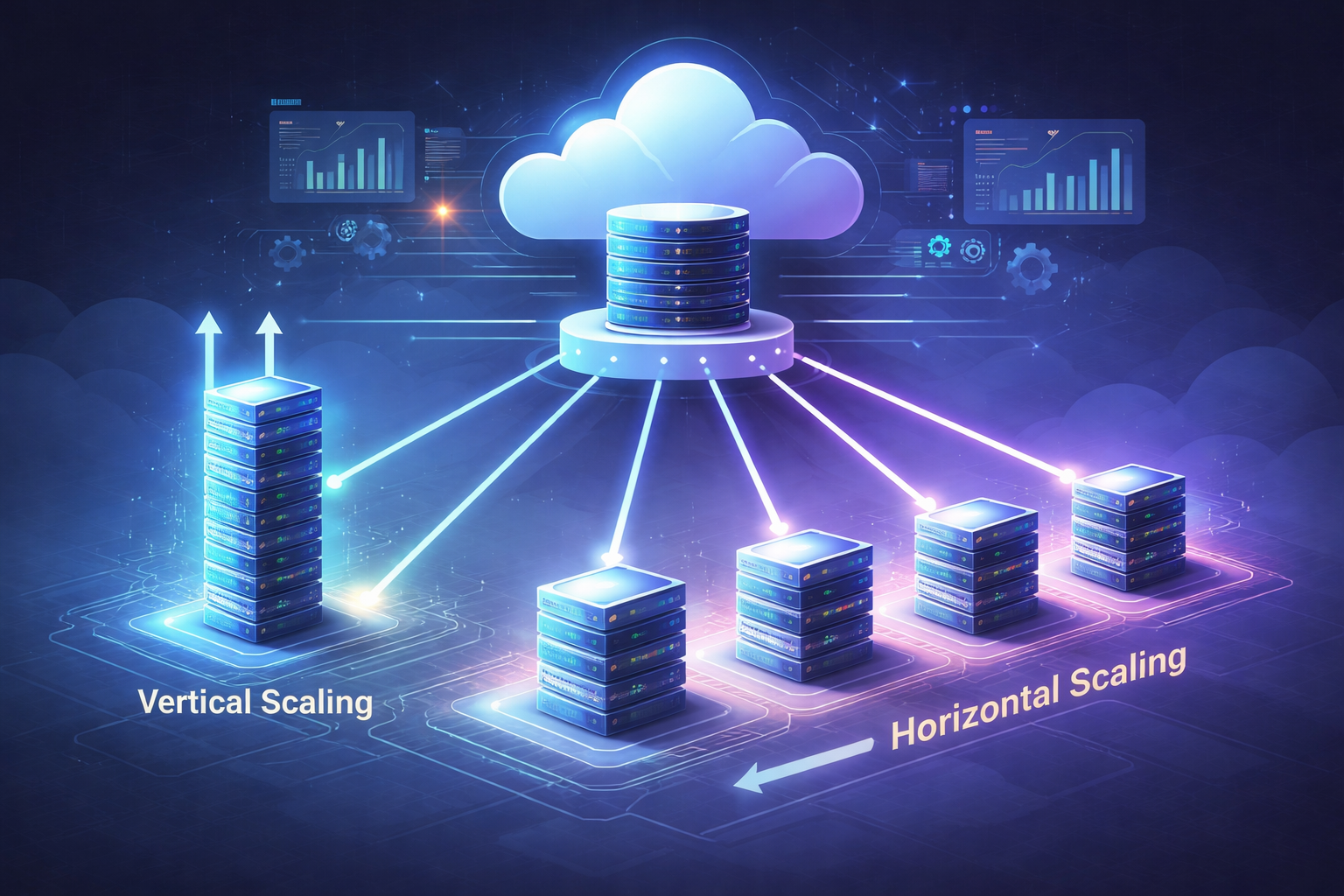
Scalability refers to a system’s ability to handle growth in users, traffic, and data. In the past, systems were often built to support a predictable workload and then gradually expanded by manually adding servers. Today, cloud infrastructure allows systems to scale up and down dynamically based on demand. Failing to take advantage of these capabilities is a competitive disadvantage.
Modern systems should be designed with scaling in mind from day one. Even if traffic is small initially, it can spike unexpectedly due to product growth, marketing campaigns, or external events. Services such as Amazon EC2 Auto Scaling groups allow instances to scale automatically based on metrics. Container based workloads using AWS Fargate can scale with minimal configuration. AWS Lambda scales by default in response to invocation volume.
Scalability is not only about growth. It is also about cost efficiency. During periods of low usage, such as overnight or seasonally, infrastructure should scale down to reduce unnecessary expense. As a manager, you do not need to configure these services yourself, but you should expect your system to adapt to real world traffic patterns. For a more intuitive walkthrough of how systems scale in practice from a single machine to distributed infrastructure How Software Systems Scale: From One Machine to Many builds that mental model from the ground up.
Reliability and Availability
Reliability and availability are closely related concepts. Reliability speaks to whether a system continues to function correctly over time. Availability focuses on whether users can access the system when they need it. In modern applications, especially customer facing systems, downtime is rarely acceptable.
If your platform handles financial transactions, downtime directly impacts revenue. Even if your system is not revenue generating, frequent outages damage user trust and retention. In a world filled with alternatives, users expect systems to be accessible around the clock.
Architecturally, this often means avoiding single points of failure. Deploying applications across multiple availability zones, using Elastic Load Balancers to distribute traffic, and configuring databases such as Amazon RDS with Multi AZ support are common patterns. High availability targets such as five nines, meaning 99.999 percent uptime, are often considered a gold standard for critical systems.
As an engineering manager, you should understand what availability target your system is aiming for and whether the architecture aligns with that expectation.
Latency
Latency refers to how quickly your system responds to user actions. Every click, search, and interaction is measured in milliseconds from the user’s perspective. External users expect near instantaneous responses for common actions. Even for internal applications, slow response times create frustration and reduce productivity.
Not all interactions require the same performance profile. Loading a large dataset for a business intelligence dashboard may reasonably take longer. However, basic transactional actions such as clicking a button or navigating between screens should feel immediate.
From a cloud perspective, latency can be reduced through content delivery networks such as Amazon CloudFront, caching layers like Amazon ElastiCache using Redis, and thoughtful geographic deployment strategies. As a manager, you should ensure your team is measuring latency and treating it as a first class concern, especially for customer facing workflows.
Consistency
Consistency becomes particularly important in distributed systems. In a single instance database, consistency concerns may be minimal. However, as systems scale and replicate data across nodes or regions, trade-offs emerge.
Imagine a scenario where data is written to one partition but has not yet propagated to another. If a user query is routed to a replica that has not been updated, they may receive stale data. In some applications, this delay is acceptable. In others, such as financial transactions, it is not.
Modern services such as Amazon DynamoDB allow you to configure read consistency levels, choosing between eventual consistency and strongly consistent reads. These decisions impact performance, cost, and user experience. As a manager, you should understand that these trade-offs exist and ensure that consistency requirements are aligned with business risk tolerance.
Fault Tolerance
Fault tolerance refers to a system’s ability to continue operating even when components fail. Failures are not theoretical. Infrastructure can degrade, network calls can time out, and unexpected user behavior can expose unhandled edge cases.
From an infrastructure perspective, services like Route 53 can support DNS failover strategies, and container orchestration platforms can restart failed tasks automatically. However, fault tolerance is not only about infrastructure. Software level error handling is equally important.
Engineering teams sometimes overlook simple defensive programming practices. If a user performs an unexpected action and the system crashes instead of responding gracefully, the experience deteriorates quickly. Handling errors cleanly and presenting meaningful messages to users is fully within the control of the development team. As a manager, you should set the expectation that systems degrade gracefully rather than fail catastrophically.
Caching
Caching improves both performance and cost efficiency by storing frequently accessed data closer to the user or application layer. Instead of repeatedly querying a primary database, commonly requested information can be retrieved from a faster intermediate store.
Examples include using Amazon ElastiCache for Redis to cache database results or leveraging edge caching through CloudFront. Caching can also occur at the client side, where certain user information is temporarily stored in the browser to avoid redundant requests.
The key is understanding cache duration and invalidation strategy. Data that changes infrequently can be cached longer. Data that updates frequently must be refreshed more often to avoid stale results. As a manager, you should understand how caching affects both user experience and data accuracy.
Partitioning
Partitioning, sometimes referred to as sharding, involves splitting data across multiple nodes to improve performance and manage scale. Large applications with global user bases often benefit from partitioning data by region or tenant.
For example, if user interactions across regions are limited, storing regional data in separate partitions can reduce query load and improve response times. Services like DynamoDB handle partitioning automatically based on access patterns, while relational databases may use read replicas or custom sharding strategies.
Partitioning introduces complexity, especially when cross partition queries are required. Managers do not need to design these strategies themselves, but they should understand when data volume or traffic patterns justify partitioning.
Security
Security is non negotiable in modern systems. Whether you operate in banking, healthcare, or consumer applications, protecting user data and preventing unauthorized access is critical.
Security must be enforced at every layer. Front end checks are helpful for user experience, but they are not sufficient. Business logic and authorization must be validated at the API layer. Database access should be restricted to system roles and not exposed directly to clients.
Cloud providers offer foundational security tools such as AWS IAM for access control, AWS WAF for application level protection, and services like GuardDuty and Security Hub for monitoring and threat detection. These tools provide baseline infrastructure security. Beyond that, architectural discipline ensures that systems are not vulnerable to misuse or exploitation.
As an engineering manager, you should ensure that security is treated as a shared responsibility between architecture, development, and operations.
Trade Offs and the CAP Theorem
None of the principles above are binary decisions. They exist on a spectrum. Optimizing for one dimension often introduces cost, complexity, or constraints in another.
For internal systems, you may accept slightly higher latency to control infrastructure costs. For external customer facing platforms, you may invest heavily in availability and security. Every context requires prioritization.
At a theoretical level, concepts like the CAP theorem highlight fundamental trade-offs between consistency, availability, and partition tolerance in distributed systems. While modern databases allow nuanced tuning rather than rigid either or choices, the underlying idea remains relevant. You cannot maximize everything simultaneously without consequence.
An engineering manager should understand that system design is ultimately about informed compromise. Your role is to ensure those compromises are deliberate and aligned with business objectives.
The Manager’s Depth
An architect may live inside these details daily. An engineering manager should not. Your goal is not to out design your architects or replace your senior engineers. Your goal is to understand enough to ask sharp questions, connect technical decisions to business outcomes, and create an environment where thoughtful design thrives.
If you are transitioning from an individual contributor or architectural background, you may feel the pull to stay deeply technical. Staying current is valuable. However, do not measure your effectiveness by whether you can still design every component yourself. Measure it by whether your team is making sound decisions and whether you can challenge them constructively. Guiding those decisions without reverting to being the architect yourself is a skill covered in detail in How to Guide Architecture Without Being the Architect.
System design literacy, not system design mastery, is the standard for engineering managers.
If you are currently in an engineering management role, how do you balance staying technically sharp with your broader leadership responsibilities? What system design principles do you find yourself revisiting most often in discussions with your team?
Did you find this useful?
Comments
Loading comments...
Please log in to post a comment.
About the author

I write about leadership and software engineering through the lens of someone who’s worked as a software engineer, product owner, and engineering manager. With a Bachelor’s in Computer Science Engineering and an MBA in IT Strategy, I bring together deep technical foundations and strategic thinking. My work is for engineers and digital tech professionals who want to better understand how software systems work, how teams scale, and how to grow into thoughtful, effective leaders.
Continue reading
Understanding Databases: How Software Systems Store and Retrieve Information
A simple mental model for understanding how software systems store information and keep it consistent at scale.
What Happens When You Click on a Website
A step-by-step look at how browsers, servers, and networks work together to load a webpage.